
The Research
This research reveals that every PE-backed CEO moves through distinct leadership seasons, often more than once. These seasons are predictable, yet rarely named or approached with intention. While CEOs apply strategy and structure to the businesses they run, few apply the same discipline to their own role evolution. The insight is simple: leadership seasons exist, and failing to recognize them increases strain, misalignment, and preventable transition risk.
In the Performance season, the PE-backed CEO carries concentrated accountability for value creation, board alignment, and capital deployment. Decisions compress under timeline pressure, and recovery narrows as execution intensity defines credibility.
In the Transition season, leadership depends on recalibrating alongside the executive team and board. Mandates soften, identity questions surface, and distributed alignment becomes essential to prevent accumulated strain from driving reactive decisions.
In the Reinvention season, integrity requires deliberate redesign before renewed contribution. Without reflection and recalibration, prior intensity patterns repeat, limiting durability and narrowing optionality across subsequent leadership chapters.
Performance Season
During the Performance season, PE-backed CEOs allocate most attention to execution tied directly to value creation plans and operating cadence. Roughly fifty-five percent of focus centers on team performance, hitting targets, resolving issues, and sustaining forward momentum across functions. Execution defines credibility, and visible progress reinforces confidence with stakeholders.
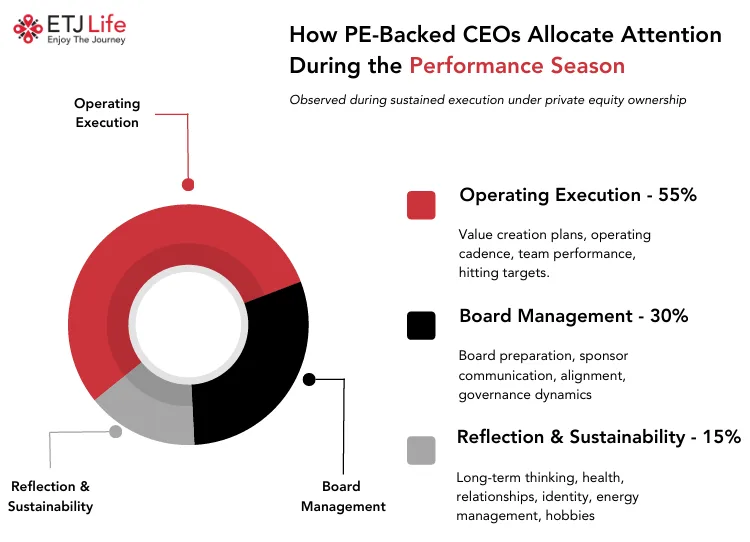
Approximately thirty percent shifts toward board management, including preparation, sponsor communication, alignment, and governance dynamics under compressed timelines. The CEO must interpret results, frame variance, and maintain trust while navigating subtle expectation shifts. Performance is not only delivered; it is constantly translated.
The remaining fifteen percent goes to reflection and sustainability, but that reflection is often tactical rather than restorative. Time is spent thinking about strategy and risk, yet less time is spent evaluating energy, identity, or long-term cost. When this imbalance persists, judgment narrows and recovery shortens. Performance can remain strong while personal capacity quietly erodes beneath the surface.
This pattern consistently appears during sustained execution under private equity ownership.
Transition Season
During the Transition season, the role that structured your time, identity, and authority is shifting, but the next role is not yet defined. Accountability softens, yet it does not disappear. Roughly twenty-five percent of attention remains tied to execution pressure, including succession planning, unresolved commitments, legacy decisions, and formal handoffs. You are still responsible, but no longer fully anchored.
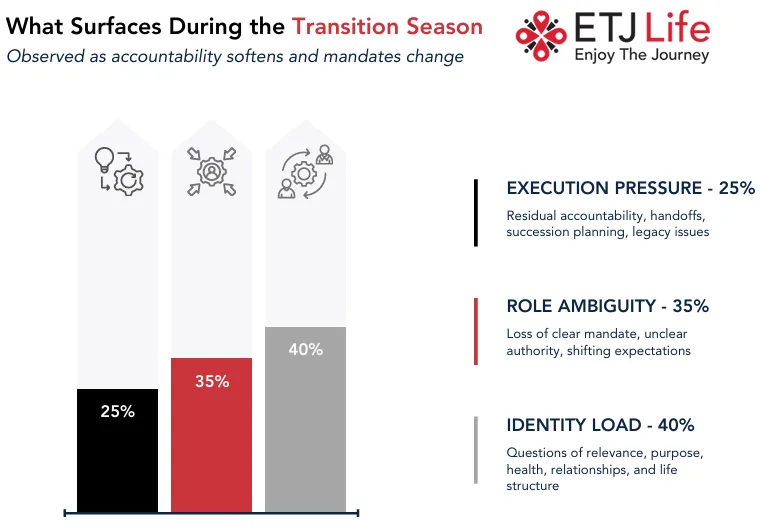
Approximately thirty-five percent of focus moves into role ambiguity. The clear mandate that once governed decisions weakens. Expectations shift, authority becomes less explicit, and the urgency that organized daily life recedes. Without the former structure, many leaders feel disoriented even if externally successful.
The remaining forty percent centers on identity load. Reflection becomes unavoidable. Questions surface about relevance, purpose, health, relationships, energy, and life design beyond performance metrics. This phase exposes accumulated cost. If rushed, leaders recreate intensity to regain clarity. If examined honestly, Transition becomes a deliberate recalibration point rather than an unstructured drift.
Reinvention Season
During the Reinvention season, contribution becomes optional rather than required. The formal mandate that once structured authority has ended or materially changed, and the leader is no longer operating under compressed capital timelines. Reinvention begins when work is chosen, not imposed.
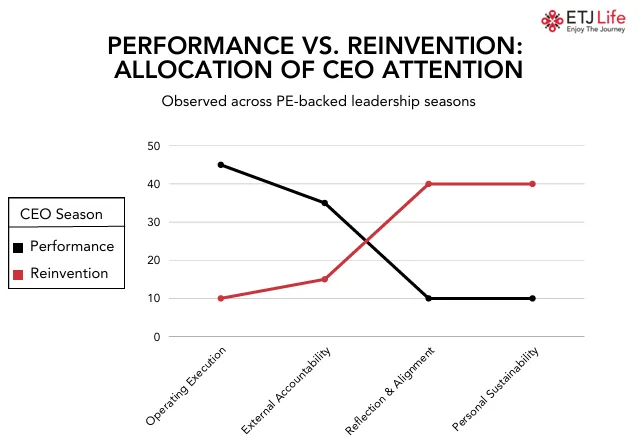
Compared to Performance, where execution dominates attention, Reinvention reallocates focus toward reflection, alignment, and intentional engagement. Operating execution narrows to areas of deliberate commitment. Board involvement becomes selective. Time previously absorbed by cadence and targets is redirected toward evaluating where energy, relevance, and impact should be applied next.
This season requires disciplined reflection. Leaders must assess what they want to build, what they are willing to carry, and what level of intensity is sustainable. Without recalibration, prior execution habits quietly reappear under new titles. When navigated deliberately, Reinvention restores coherence between identity and contribution and expands durability across future leadership chapters.
A Season-Based Approach
to the CEO Role
The PE-backed CEO role has long been treated as a single job defined by execution under capital pressure. Our research shows the role evolves through distinct seasons that demand different allocations of attention and energy. In other words, leadership durability depends on recognizing when the operating season has changed and adjusting accordingly.
Across Performance, Transition, and Reinvention, the leaders who sustained clarity were those who operated with explicit intention. They defined what they were building, why it mattered, and what personal cost they were willing to carry. When intention was absent, urgency filled the gap. Execution remained strong, but reflection narrowed. Over time, that narrowing shaped tenure, decision quality, and the structure of second chapters more than quarterly results ever did.
This research points toward a different model. The CEO role should be approached seasonally, not statically. Intention, clarity, and purpose must be treated as operating disciplines rather than personal preferences. When leaders and boards align around the season, accountability remains high while strain becomes organized instead of accidental.
Operating Discipline
Season-based leadership demands structured intention and explicit clarity rather than reactive execution. CEOs who documented purpose, energy allocation, and long-term direction demonstrated steadier judgment across shifting ownership conditions. In other words, intention and clarity function as operating tools, not abstract ideals.
During Transition and Reinvention, clarity determined whether recalibration preceded redesign or followed avoidable missteps. Leaders without written intention defaulted to urgency, narrowing perspective before recognizing the cost.
Structural Isolation
More than ninety percent of CEOs described lacking a consistent environment where business exposure and personal strain could be discussed without consequence. This isolation was structural, not emotional. Leaders who intentionally built space for challenge, reflection, and season recognition maintained broader perspective and stronger long-term durability across ownership cycles.
Recognize the Season.
Adjust the Approach.
The existence of leadership seasons is not a theory. It is an observed reality across every PE-backed CEO engaged in this research. Performance, Transition, and Reinvention are not anomalies; they are recurring conditions of the role. Yet most leaders apply strategy and discipline to the businesses they run while approaching their own evolution reactively.
If there is a call embedded in this work, it is this: apply the same rigor to the season you are in as you apply to the company you lead. Name it. Define it. Allocate attention intentionally. In Performance, protect recovery before capacity narrows. In Transition, recalibrate before urgency recreates itself. In Reinvention, design deliberately before momentum returns by habit.
Leadership durability is not accidental. It is structured. Boards that recognize seasons govern differently. CEOs who recognize seasons decide differently. Clarity does not remove pressure; it organizes it. Intention does not soften standards; it sharpens them.
Every CEO will move through these seasons, often multiple times. The only question is whether the shift will be recognized early or explained later.
The role changes. The season changes. The approach must change with it.
About ETJ Life
ETJ Life helps PE-backed CEOs thrive in work and life across Performance, Transition, and Reinvention. We combine structured reflection, disciplined coaching, and a trusted peer community so leaders do not carry the role alone.
Our focus is leadership durability — sustaining clear thinking, steady decision-making, and personal alignment under concentrated capital pressure. Through structured coaching and a trusted peer community, we help CEOs recalibrate between seasons and lead with intention across the full arc of the role and their lives.